

Suitable for Propagation

Allium Karataviense is a gorgeous low allium variety that, with cream/pink coloured star-shaped flowers on short stems and large leaves, fits perfectly among low perennials.
Read more
An enchanting allium variety, Allium Miami has red-purple semi-circular flowers and stands on tall sturdy stems. Ideal for between perennials.
Read more
Allium Moly is a small species of Allium. Golden-yellow flower heads and grey-tinged leaves. Plant between perennials or roses or just at the edge of the border.
Read more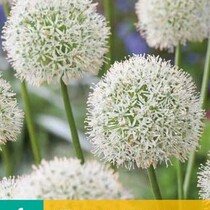
The Allium Mount Everest is one of the longest Allium species (125 cm long) and therefore eye-catching in the garden. The pure white flowers collectively resemble a large snowball.
Read more- Bezorgkosten 6,95 NL en 8,95 BE
- Snelle Levering (per product vermeld)
- Gratis bezorging vanaf 60 euro
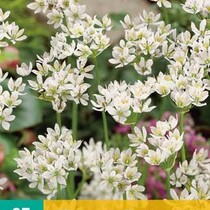
Also called white garlic, Allium Neapolitanum dies off in summer. New growth comes in late autumn and the edible leaves are there during part of the winter.
Read more
Allium Nigrum is a tall allium with a semi-spherical screen of creamy white flowers that feature a green heart. A suitable bulb for gardens with a natural look.
Read more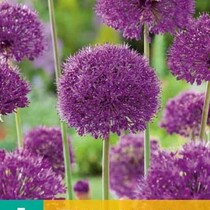
Allium Purple Sensation is a beautiful ornamental onion with a deep purple colour, this allium granted itself perfectly between perennials and or late tulips. This allium returns beautifully every year.
Read more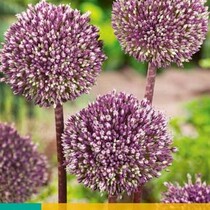
Allium Summer has purple flowers, this allium species is a good nectar source and attracts many pollinators such as bees, bumblebees and butterflies.
Read more- Bezorgkosten 6,95 NL en 8,95 BE
- Snelle Levering (per product vermeld)
- Gratis bezorging vanaf 60 euro

The Allium Caeruleum has beautiful sky-blue flowers, which stand on 40 cm long sturdy stems. This allium is also suitable as a cut flower.
Read more
Buy Allium Gladiator affordably at Garden Select. Large selection in bulk packs at the lowest prices.
Read more
The Allium Red Giant is a jewel in any garden, this low allium with its red/purple flowers combines perfectly with perennials. The flowers can reach a diameter of 10 cm.
Read more
The Allium Mount Everest is a stunning allium variety with large creamy white flowers measuring 15 cm across and standing on tall stems about 100 cm tall.
Read moreAlliums (Ornamental onions)
The genus Allium has many species and cultivars. We offer a number of large-flowered Alliums and a number of Alliums suitable for naturalising.
The large-flowered Alliums (Dutch name: sierui or garlic) prefer a sunny spot, but also thrive in partial shade. Ornamental onions flower when most perennials have only green leaves. They are therefore great for combining with perennials. Plant them in large numbers, give them some extra fertiliser every spring and enjoy a blooming border in May and June! When planting, pay attention to the height of the ornamental onions and perennials: During flowering, the ornamental onions should stick out above the perennials! Flowering Alliums may disappear under the leaves of the perennials later in the season.
How do you propagate Allium (Ornamental Onion)?
Propagating ornamental onions can be done generatively by seed or vegetatively by daughter bulbs. Sowing out makes sense only with pure bulb varieties. Until the seed has developed into a bulb that can flower, several years may pass.
Is Allium (ornamental onion) perennial?
The majority of Allium are perennial bulbs. When digging up the larger varieties, 2 bulbs together form one plant. One bulb is sold and the other replanted. After flowering, they can remain for years. The leaves draw nutrition from sunlight and strengthen the bulb, which blooms again the following year. Let the leaves turn yellow before removing them; this energises the bulbs. They can also spread by seed. Sowing and raising them is easy. The species A. moly, A. oreophilum, A. sphaerocephalon, A. stipitatum, A. atropurpureum, A. caeruleum, A. cernuum, A. flavum, A. puchellum, A. triquetrum, A. ursinum and A. zebdanense are suitable for naturalising.
Where do I plant Allium (ornamental onion)?
Most ornamental onions do well in the sun, in well-drained soil. Plant the tallest varieties in a protected spot so that the stems are not too much of a nuisance when it is windy. In gardens with more shade, you can plant Allium moly.